- Worldwide Delivery
- Quality Guaranteed
- Bonus pills
- 24/7 Support
By binding corticosteroid receptors in the skin, clobetasol propionate in Cosvate cream slows immune signals that drive redness, swelling, and itch. Cosvate cream is intended for people with severe, corticosteroid-responsive inflammatory skin flares, such as resistant eczema or dermatitis. Its benefit is focused local anti-inflammatory relief when used in a limited, clinician-directed course.
Overview
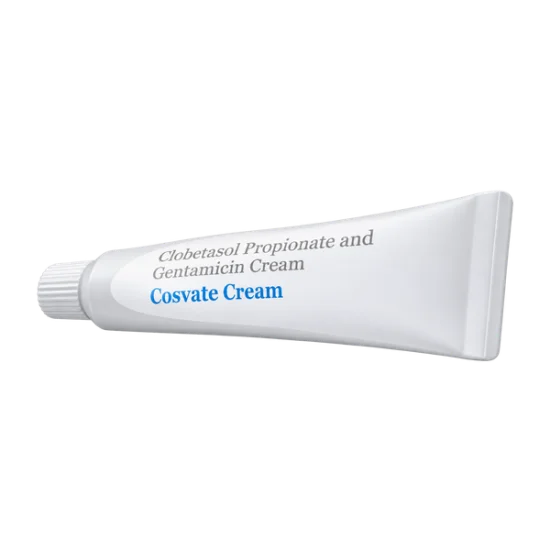
Cosvate cream contains clobetasol propionate, a super-potent topical corticosteroid. It acts in the skin rather than treating inflammation throughout the body, provided it is used on small affected areas and for the prescribed period.
Dosage and administration
Cosvate cream is for topical use on the affected skin only. The amount per application and treatment schedule are set individually, based on the diagnosis, site of application, skin thickness, age, and response.
Use the cream in this order:
- Wash and dry your hands before application.
- Place a small amount on the inflamed area.
- Spread it gently into a thin, even film.
- Wash your hands afterward unless the hands are the treatment area.
- Keep the treated skin uncovered unless a clinician has specifically advised a dressing.
More cream does not work faster.
Avoid using Cosvate cream on large areas, under airtight dressings, or on damaged skin unless specifically directed. Occlusion greatly increases absorption through the skin. The same issue can arise in skin folds, beneath tight clothing, or under diapers.
Do not use it as a daily maintenance cream once the active flare has settled. Emollients are the maintenance product; clobetasol is the flare-control treatment.
Formulation
Cosvate cream contains clobetasol propionate, a super-potent topical corticosteroid. It acts in the skin rather than treating inflammation throughout the body, provided it is used on small affected areas and for the prescribed period. The FDA (Food and Drug Administration) classifies clobetasol products among the most potent topical corticosteroids because of their strong anti-inflammatory activity. [1]
Clobetasol reduces inflammatory chemicals released in irritated skin. This eases itch, redness, scaling, thickening, and swelling associated with steroid-responsive dermatoses.
A thin film is enough.
How it affects the body
Clobetasol propionate enters superficial skin cells and binds to glucocorticoid receptors. This changes gene activity inside the cell, reducing production of inflammatory mediators such as cytokines, prostaglandins, and leukotrienes. It also narrows small blood vessels in inflamed skin, which helps reduce visible redness and swelling.
Therapeutic indications
Cosvate cream is used for short-term control of severe inflammatory skin conditions that respond to topical corticosteroids. Dermatologists may use a super-potent steroid when milder treatment has not controlled a localized flare, or when plaques are thick, very itchy, and inflamed.
Common clinical uses include:
- Severe eczema with marked itch and skin thickening
- Contact dermatitis caused by an irritant or allergen
- Localized psoriasis plaques, excluding areas where high-potency steroids are unsuitable
- Lichen simplex chronicus, where repeated scratching has thickened the skin
- Other inflammatory dermatoses assessed as corticosteroid-responsive
Eczema often damages the skin barrier, allowing moisture to escape and irritants to penetrate more easily. Clobetasol calms the inflammatory phase, but it does not remove the original trigger, such as fragrance exposure, nickel, harsh detergents, or recurrent scratching. A 2022 Cochrane review found that topical corticosteroids improve eczema control, with potency selected according to the body site and flare severity. [2]
Cosvate cream is not intended to treat every rash. Ring-shaped, spreading, crusted, blistering, or painful eruptions need a proper clinical assessment before a potent steroid is applied.
Common mistakes
The most frequent mistake is treating every rash as eczema. A fungal infection can temporarily look less red with a steroid while continuing to spread underneath the surface.
Other mistakes include:
- Applying Cosvate cream to the face because facial redness is distressing
- Using it after a rash has cleared, as a preventive daily product
- Covering the area tightly to make the cream absorb faster
- Applying it immediately after a hot shower, when skin is more permeable
- Sharing the cream with another person who has a similar-looking rash
- Continuing it when painful crusting, pus, or rapid expansion develops
Reasons not to use it
- A known allergy to clobetasol, corticosteroids, or cream ingredients
- Suspected bacterial, fungal, or viral skin infection without appropriate treatment
- Facial, eyelid, genital, groin, or underarm application
- Large treatment areas or prolonged repeat courses
- Use beneath airtight bandages, plastic coverings, or diapers
- Infants and children, who absorb proportionally more topical corticosteroid through the skin
- Pregnancy or breastfeeding, where treatment area, duration, and site require individualized clinical judgment
Topical clobetasol can suppress the hypothalamic-pituitary-adrenal axis when enough drug is absorbed through the skin. This is more likely with extensive application, broken skin, occlusive coverings, and repeated long courses. The FDA prescribing information warns against use for certain untreated infections and against extended application patterns that raise systemic absorption. [5]
When this is not for you
This is not for you if you have an untreated viral skin infection, including herpes simplex lesions or chickenpox-related skin changes, at the proposed treatment site. It should also be avoided on rosacea, acneiform eruptions, open wounds, and unexplained ulcers unless a clinician has made a specific diagnosis.
Possible side effects
Most unwanted effects occur at the application site. Mild burning, stinging, dryness, irritation, or temporary redness may appear after application, especially when inflamed skin is cracked. These sensations should be brief rather than progressively worsening.
Prolonged or excessive exposure can cause more significant steroid effects:
| Reaction type | What it may look like |
|---|---|
| Local irritation | Burning, stinging, itching, redness, or dryness |
| Skin changes | Thinning, easy bruising, stretch marks, visible small blood vessels, or altered pigmentation |
| Infection-related concern | Increasing pain, warmth, pus, crusting, spreading redness, or failure of the rash to improve |
| Systemic absorption | Unusual fatigue, facial puffiness, or other features of corticosteroid excess after extensive use |
Skin atrophy develops gradually and is easier to prevent than reverse. The face, eyelids, groin, armpits, and skin folds absorb topical corticosteroids more readily, so these areas carry a higher risk of thinning. MedlinePlus lists burning, stinging, irritation, acne-like eruptions, and skin color changes among possible reactions to topical clobetasol. [3]
Comparison
Treatment choice depends on diagnosis, body site, severity, and whether infection is present. Clobetasol is not the first choice for delicate areas or long-term maintenance, even when it controls symptoms quickly.
| Treatment approach | Clinical role | Main limitation |
|---|---|---|
| Clobetasol topical therapy | Short-term control of severe, thick, localized inflammatory plaques | High risk of skin thinning if overused |
| Medium-potency topical corticosteroid | Moderate flares or sites requiring less potent treatment | May be insufficient for thick, resistant plaques |
| Topical calcineurin inhibitor | Sensitive areas and steroid-sparing maintenance in selected inflammatory dermatoses | Can cause transient burning and is not suited to every diagnosis |
For thick plaques on the elbows, knees, palms, or soles, a clinician may select a stronger steroid approach. For eyelids, facial skin, and skin folds, lower-potency corticosteroids or nonsteroidal anti-inflammatory options are often preferred. The American Academy of Dermatology’s 2023 guidance supports matching topical treatment intensity to disease severity and treatment location rather than using the strongest steroid by default. [4]
What doctors say
In dermatology practice, the key question is not whether a rash is itchy. It is why the rash is itchy. Psoriasis, allergic dermatitis, fungal infection, scabies, bacterial infection, and eczema can overlap in appearance, while requiring very different treatment plans.
Clinicians usually expect Cosvate cream to reduce active inflammation during a short, defined course. They also look for objective signs of improvement: less redness, reduced thickening, fewer scratch marks, and better sleep due to reduced itch. If the treated area spreads, becomes painful, oozes, or develops a sharply defined advancing edge, the diagnosis may need reassessment rather than stronger or longer steroid use.
A common real-world issue is intermittent overuse. A person may apply a potent steroid whenever itch returns, without addressing moisturizer use, triggers, or the possibility of infection. That pattern can create a cycle of brief relief followed by repeated flares.
Common questions
How long does one application of Cosvate cream keep working?
Clobetasol begins acting in the skin after application, while visible relief of itch and redness may continue between applications. The effect is not permanent because inflammatory triggers and skin-barrier damage can persist after symptoms ease. FDA prescribing information from 2021 describes clobetasol as a high-potency topical corticosteroid intended for limited courses rather than continuous maintenance use. The prescriber-directed schedule is designed to balance control with the risk of excessive absorption. Follow the prescribed frequency even when symptoms improve.
Can Cosvate cream be combined with oral corticosteroids or other steroid-containing treatments?
Combining topical clobetasol with oral corticosteroids, steroid injections, inhalers, or other steroid creams can increase total corticosteroid exposure. This may matter if treatment covers a large area, lasts beyond the planned course, or involves occlusion. The FDA advises clinicians to consider cumulative corticosteroid exposure when evaluating adrenal suppression risk. Before starting, list all prescription, over-the-counter, inhaled, nasal, injected, and skin-applied steroid products used during the previous months.
What should be discussed with a doctor before starting Cosvate cream?
Discuss the exact diagnosis, location of the rash, symptom duration, prior steroid use, skin infections, and whether the skin is broken or weeping. Mention diabetes, immune suppression, pregnancy, breastfeeding, and any history of reactions to topical medicines. The American Academy of Dermatology’s 2023 topical-therapy guidance emphasizes tailoring treatment to body site and disease severity. Photos taken before treatment can help a clinician judge whether the area is truly improving rather than merely becoming less red.
Does a viral skin infection rule out Cosvate cream?
Yes. Active viral skin infections at the treatment site, including herpes simplex lesions and chickenpox-related lesions, are a reason to avoid topical clobetasol unless a clinician directs otherwise. Suppressing local immune activity may allow an infection to worsen or change appearance. FDA prescribing information published in 2021 lists untreated infections among situations requiring caution. Seek prompt assessment for grouped blisters, fever, rapidly spreading pain, or skin lesions near the eyes.
What should be done after a missed application?
Apply the next scheduled application when remembered if there is still a reasonable interval before the next one. Do not apply extra cream or create a thicker layer to compensate for the missed application. The FDA’s 2021 patient information for topical corticosteroids supports using treatment as directed rather than doubling exposure. Missing one application is less concerning than repeatedly overapplying a super-potent steroid.
Do you offer anonymous delivery?
Your order will be securely packed and shipped within 24 hours. This is exactly what your package will look like (images of an actual item sent). It has the size and look of a regular private letter (9.4x4.3x0.3 in.) and its contents cannot be seen.
Customer Feedback on Cosvate cream
Sources
- FDA (2021). TEMOVATE prescribing information.
- Cochrane (2022). Topical corticosteroids for eczema.
- National Library of Medicine (2024). Clobetasol Topical.
- American Academy of Dermatology (2023). Guidelines of care for the management of atopic dermatitis in adults with topical therapies.
- FDA (2021). Clobetasol propionate topical corticosteroid prescribing information.