
Mark, 28
Oct 26, 2026
It did not improve my itching enough to justify the sleepiness. I felt slowed down during the day and stopped after speaking with my doctor.
Black Friday +8 free tablets with every order Nov 19 – Dec 2
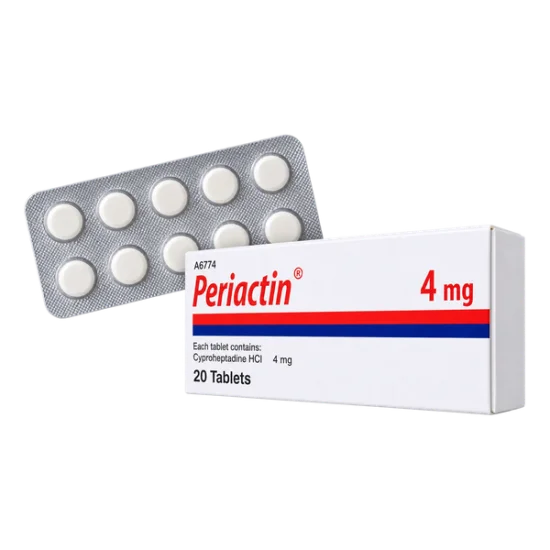
Periactin tablets are taken by mouth, with or without food, for the prescribed treatment of allergic symptoms. They contain cyproheptadine hydrochloride, an antihistamine that reduces itching, hives, runny nose, and watery eyes.
Periactin contains cyproheptadine hydrochloride, a first-generation antihistamine. The drug is prescribed for allergic conditions such as urticaria, allergic rhinitis, itching, and related histamine-mediated symptoms.
Cyproheptadine belongs to the sedating, first-generation antihistamine group. Unlike newer non-sedating antihistamines, it crosses the blood-brain barrier and can affect the central nervous system. Sleepiness, slowed reaction time, reduced concentration, and impaired coordination can follow.
This central action is the main trade-off. Periactin can reduce allergy symptoms, yet it may be unsuitable when alertness is essential. Driving, cycling in traffic, climbing, and operating machinery require extra caution until the individual response is clear.
The prescribed regimen for the selected strength should be confirmed with a healthcare professional before starting. Periactin tablets are swallowed by mouth with water and may be taken with food or on an empty stomach.
Food is not required for absorption, although taking the tablet with food may be more comfortable for people who notice stomach irritation. Alcohol can intensify drowsiness and impaired coordination. Sedating medicines, sleep aids, opioid pain medicines, and some anxiety medicines can produce a similar additive effect.
One practical detail is easy to overlook: reduced alertness can occur even when the person does not feel strongly sleepy. A slower reaction to sudden traffic or machinery may be the first sign.
Periactin contains cyproheptadine hydrochloride, a first-generation antihistamine. The regimen for the chosen strength should be confirmed with a healthcare professional before starting.
Histamine is a chemical messenger released during an allergic reaction. It can widen small blood vessels, increase tissue swelling, stimulate itching, and promote nasal or eye symptoms. Cyproheptadine blocks histamine H1 receptors, reducing the effect of histamine on affected tissues.
Cyproheptadine also has antiserotonergic activity. This means it blocks certain serotonin receptors, which helps explain its appetite-stimulating effect and some of its other pharmacological properties. The FDA prescribing information describes cyproheptadine as an antihistamine with antiserotonergic effects [1].
The drug is prescribed for allergic conditions such as urticaria, allergic rhinitis, itching, and related histamine-mediated symptoms.
Several practical mistakes can reduce benefit or increase risk:
The tablet should not be crushed or chewed unless a prescriber or pharmacist has specifically confirmed that approach for the individual product. Crushing can make swallowing easier, yet it may also create an inaccurate dose if the person cannot take the full amount.
Monoamine oxidase inhibitors can intensify and prolong the anticholinergic effects of cyproheptadine.
This medication is not for you if you have a known allergy to cyproheptadine or a component of the tablet, or if a clinician has identified a contraindication specific to your health history.
Children need age-appropriate prescribing. Cyproheptadine should not be used to make a child gain weight without a defined clinical reason, nutritional assessment, and medical supervision. The WHO describes antihistamine safety as strongly dependent on age, dose, and concurrent medicines [3].
The most familiar adverse effect of Periactin is sedation. Dry mouth, dizziness, blurred vision, fatigue, increased appetite, and constipation can also occur because cyproheptadine affects histamine and other neurotransmitter systems. The FDA and National Library of Medicine describe these effects as characteristic concerns with cyproheptadine treatment [2].
Common effects include:
Drowsiness can be substantial. Avoid driving until the response is predictable. Alcohol makes this worse. Older adults may experience confusion, urinary difficulty, falls, or pronounced sedation more readily than younger adults.
Dry mouth may improve with regular sips of water and careful oral hygiene. Constipation may respond to adequate fluids and dietary fiber when those measures are medically appropriate. Blurred vision, severe dizziness, or persistent palpitations need prompt medical assessment rather than self-treatment.
Rare but serious reactions can include severe confusion, hallucinations, seizures, difficulty urinating, significant breathing difficulty, swelling of the face or throat, or a widespread blistering rash. Emergency care is appropriate for breathing difficulty, facial swelling, collapse, or a seizure.
Periactin differs from newer allergy medicines because cyproheptadine enters the brain more readily. This gives it a stronger sedating profile than many second-generation antihistamines.
| Medicine or ingredient | Sedation potential | Common clinical role |
|---|---|---|
| Cyproheptadine in Periactin | Moderate to high | Hives, itching, allergic rhinitis, selected appetite-related uses |
| Diphenhydramine in Benadryl; promethazine in Phenergan; hydroxyzine in Atarax | Moderate to high | Allergy symptoms, itching, nausea, anxiety, or sleep-related uses depending on the ingredient |
| Loratadine in Claritin; cetirizine in Zyrtec | Lower for many users, though cetirizine can still cause drowsiness | Allergic rhinitis and urticaria |
Phenergan, Atarax, and Benadryl are not interchangeable with Periactin. Their active ingredients, dosing schedules, approved uses, and interaction profiles differ. Claritin and Zyrtec may be preferred when daytime alertness is a priority, while cyproheptadine may be selected for a clinical situation in which its broader receptor activity is useful.
In clinical practice, doctors often judge Periactin by two separate outcomes: control of histamine-related symptoms and the degree of central nervous system sedation. A useful response with disabling sleepiness may require a different treatment plan rather than a higher dose.
Physicians also look for the reason behind treatment. Persistent hives may reflect chronic urticaria, an infection, a medicine reaction, or another condition requiring evaluation. Recurrent nasal symptoms may involve allergic rhinitis, irritant exposure, or asthma. Cyproheptadine can reduce symptoms without identifying the cause. The underlying cause still requires appropriate evaluation.
A doctor would usually ask about alcohol use, driving, glaucoma, urinary symptoms, seizure history, pregnancy, breastfeeding, and all medicines that cause drowsiness. This questioning is clinically relevant because the most serious problems often arise from combinations rather than from cyproheptadine alone.
Appetite increase should not be treated as proof that the body needs more calories. Unintended weight loss, poor appetite, swallowing difficulty, abdominal symptoms, or growth concerns require assessment of the underlying cause. Cyproheptadine may be considered in selected cases, but it does not replace nutritional treatment or evaluation.
The FDA prescribing information available in 2025 allows the timing to be arranged around the prescribed regimen and the patient’s response. Because cyproheptadine can cause drowsiness, an evening dose may be practical when the regimen permits, though some patients require daytime dosing for daytime symptoms. A clinician should determine the schedule when multiple daily doses are prescribed. Do not move every dose to bedtime without confirming that the revised timing still covers the symptoms being treated.
Pediatric use depends on age, weight, medical reason, and the prescriber’s instructions. The American Academy of Pediatrics has long emphasized careful dosing of sedating medicines in children, including in guidance published in 2021, with extra attention to accidental administration and respiratory effects. Periactin should not be used solely as a general appetite booster for a child without evaluation of growth, nutrition, and underlying illness. Children may show unusual excitation instead of sleepiness, so behavior changes deserve attention.
Drowsiness is a well-known effect of cyproheptadine. The National Institute on Aging highlighted in 2023 that sedating medicines can increase fall and confusion risks in older adults, and the same concern applies to anyone combining several central nervous system depressants. Avoid alcohol and do not drive until the personal response is known. Sleepiness that is severe, persistent, or accompanied by confusion needs medical review.
The FDA tablet information from 2025 does not make tablet manipulation a routine substitute for an individualized dosing plan. Swallowing the tablet with water is preferred unless a healthcare professional has given a specific alternative. Splitting may produce unequal portions if the tablet is not designed for accurate division, while crushing or chewing can make the taste unpleasant and complicate complete dose administration. A liquid formulation or another treatment may be more appropriate when swallowing is difficult.
Older adults can be more sensitive to cyproheptadine’s sedating and anticholinergic effects. Guidance from the American Geriatrics Society in 2023 supports caution with first-generation antihistamines because of confusion, constipation, urinary retention, blurred vision, and falls. A prescriber should review kidney function, glaucoma risk, prostate symptoms, fall history, and other medicines before treatment. New confusion, unsteadiness, or difficulty urinating should be reported promptly.
Your order will be securely packed and shipped within 24 hours. This is exactly what your package will look like (images of an actual item sent). It has the size and look of a regular private letter (9.4x4.3x0.3 in.) and its contents cannot be seen.
