- Worldwide Delivery
- Quality Guaranteed
- Bonus pills
- 24/7 Support
By increasing serotonin signaling between nerve cells, escitalopram—the active ingredient in Lexapro—supports treatment of major depressive disorder and generalized anxiety disorder in adults. Its dose is individualized according to the condition, response, and tolerability.
Overview
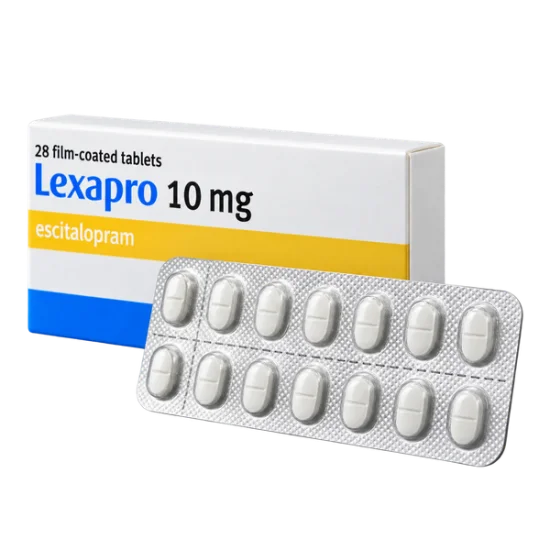
Lexapro is an FDA-approved selective serotonin reuptake inhibitor taken as a daily film-coated tablet. Its active ingredient is escitalopram, which belongs to the selective serotonin reuptake inhibitor class, commonly abbreviated SSRI. Dosing differs between strengths and between users, so no single amount suits everyone.
Dosage and administration
Lexapro is taken orally as a film-coated tablet. The dose for major depressive disorder or generalized anxiety disorder is individualized according to the condition, response, and tolerability. Dosing differs between strengths and between users, so no single amount suits everyone.
A clinician may use a lower starting amount for some older adults, people with liver impairment, or patients who are sensitive to activating effects. Dose changes should be gradual and medically directed.
Practical administration
- Take one daily dose at approximately the same time.
- Swallow the tablet with water.
- Take it with food or on an empty stomach.
- Continue treatment for the prescribed duration, even if early improvement is modest.
- Do not stop suddenly after regular use.
- If a dose is missed, take it when remembered unless the next dose is close.
- Skip the missed dose when the next scheduled dose is near.
- Do not take two doses together to compensate.
Lexapro can be taken in the morning or evening. Morning dosing may suit someone who feels more alert after taking it; evening dosing may suit someone who becomes sleepy. If it causes insomnia, moving the dose earlier can help. If it causes drowsiness, an evening schedule may be more practical. Daily timing should remain consistent once a workable schedule is established.
A common mistake is judging the treatment too soon. Early nausea, headache, restlessness, or sleep changes may appear before mood benefits. Therapeutic improvement develops over time, while full benefit can take longer.
Formulation
Lexapro contains escitalopram, the active component of escitalopram oxalate. It belongs to the selective serotonin reuptake inhibitor class, commonly abbreviated SSRI. Dosing differs between strengths and between users, so no single amount suits everyone.
How it affects the body
Serotonin is a chemical messenger involved in mood, anxiety, sleep, appetite, and emotional processing. After serotonin is released between nerve cells, the sending cell normally reabsorbs part of it. Escitalopram inhibits this reuptake process, leaving more serotonin available for signaling in the synaptic space.
The effect is gradual. Lexapro does not produce an immediate sedative or euphoric response. Pharmacological references describe escitalopram as the therapeutically active S-enantiomer of citalopram, which helps explain its selective serotonin activity [1].
Therapeutic indications
The FDA approves Lexapro for major depressive disorder in adults and adolescents aged 12 years and older. It is also approved for generalized anxiety disorder in adults. These conditions involve persistent symptoms that interfere with work, relationships, sleep, concentration, or ordinary daily activities.
Major depressive disorder can include depressed mood, loss of interest, guilt, low energy, changes in sleep, appetite changes, slowed thinking, and suicidal thoughts. Generalized anxiety disorder involves excessive, difficult-to-control worry across several areas of life, often accompanied by restlessness, muscle tension, irritability, fatigue, or sleep disturbance.
Lexapro may be selected when a clinician wants an SSRI with a relatively focused serotonergic mechanism. It is not a treatment for every form of anxiety or low mood. Obsessive-compulsive disorder, panic disorder, post-traumatic stress disorder, and social anxiety disorder may be treated with escitalopram in some clinical settings, but these uses are outside the FDA-approved Lexapro indications in the United States.
The FDA prescribing information identifies Lexapro as an oral treatment for depression and generalized anxiety disorder. Its clinical role depends on diagnosis, symptom severity, age, previous treatment, other medicines, and suicide-risk assessment [2].
Therapeutic goals
Treatment goals can include:
- Fewer depressive symptoms and improved interest in ordinary activities.
- Reduced excessive worry and physical tension.
- Delayed improvement can make early treatment difficult to evaluate.
- More stable sleep and daily functioning.
- Lower risk of relapse after sustained improvement.
- Better ability to participate in psychotherapy and normal routines.
- Nausea, sexual side effects, and withdrawal symptoms may limit treatment.
Improvement is not always linear. A person may sleep better before motivation improves, or experience less physical anxiety before mood lifts. Partial improvement deserves clinical review rather than an automatic dose increase.
Common mistakes
Several habits reduce the chance of a good result:
- Stopping after the first improvement instead of following the planned course.
- Taking extra tablets after a difficult day.
- Alternating doses to reduce sexual side effects without medical guidance.
- Combining Lexapro with St John’s wort or another antidepressant.
- Drinking heavily while trying to judge whether treatment causes fatigue.
- Failing to mention ibuprofen, naproxen, aspirin, or anticoagulants.
- Treating early restlessness as proof that the medicine will never help.
- Stopping suddenly after regular use.
- Expecting Lexapro to relieve acute anxiety within minutes.
- Hiding suicidal thoughts, agitation, or emerging manic symptoms.
One easily missed detail is the difference between withdrawal symptoms and relapse. Dizziness, electric-shock sensations, irritability, vivid dreams, and flu-like feelings soon after abrupt cessation can reflect discontinuation. A return of persistent low mood or worry may indicate relapse. The timing helps a clinician separate the two.
Another practical issue is urine testing. Escitalopram is not an amphetamine, opioid, or benzodiazepine, but medication histories should still be disclosed when laboratory results are unexpected. Accurate medication reconciliation prevents confusion.
Reasons not to use it
Lexapro is not suitable for everyone. It should not be used with monoamine oxidase inhibitors, including certain antidepressants and the antibiotic linezolid, because of the risk of severe serotonin toxicity. A washout interval is required when switching between an MAOI and escitalopram.
Benzodiazepines may be prescribed alongside an SSRI in selected cases, but the combination can increase sedation, impaired coordination, falls, and dependence-related concerns. Other medicines requiring review include tramadol, lithium, triptans, St John’s wort, other antidepressants, anticoagulants, antiplatelet drugs, and nonsteroidal anti-inflammatory drugs.
Escitalopram can increase bleeding tendency when combined with aspirin, ibuprofen, naproxen, warfarin, or other medicines affecting clotting. It can also contribute to low sodium, especially in older adults or people taking diuretics.
When this is not for you
Lexapro is not for you if:
- You currently use an MAOI or have recently stopped one without an appropriate washout period.
- You have had a serious allergic reaction to escitalopram or citalopram.
- You have bipolar disorder and the current episode has not been assessed for mania or hypomania.
- You have uncontrolled epilepsy or a history of seizures that has not been reviewed.
- You have significant liver disease requiring dose adjustment that has not been addressed.
- You take medicines that lengthen the QT interval or have a known serious heart-rhythm disorder.
- You have untreated low sodium, a history of severe hyponatremia, or conditions that increase this risk.
- You are taking several serotonergic medicines without a prescriber’s review.
Antidepressant treatment carries an FDA boxed warning about increased suicidal thoughts and behaviors in some children, adolescents, and young adults, especially during early treatment or dose changes. Any new suicidal thinking, severe agitation, or unusual impulsivity needs urgent clinical attention. The FDA warning does not mean treatment should be stopped abruptly.
Possible side effects
The most frequently reported effects of escitalopram include nausea, headache, dry mouth, sweating, insomnia, sleepiness, fatigue, dizziness, constipation, and sexual dysfunction. Some people experience increased nervousness or restlessness during the first days of treatment. These effects may lessen as the body adapts, though sexual side effects can persist during continued treatment.
Lexapro can also affect appetite, weight, orgasm, ejaculation, or libido. A patient may feel mentally calmer yet notice reduced sexual responsiveness. This is a real treatment trade-off and should be discussed openly rather than tolerated silently.
Nausea is often easier to manage when the tablet is taken with a light meal. Drinking water regularly can ease dry mouth. Alcohol, dehydration, and irregular sleep can make dizziness or fatigue feel worse.
Serious symptoms require prompt medical attention. These include severe agitation, confusion, fever, sweating, muscle rigidity, tremor, diarrhea, fainting, seizures, unusual bleeding, severe allergic swelling, or new suicidal thoughts. Serotonin syndrome is uncommon but can occur when serotonergic medicines are combined or used in excessive amounts.
Some people experience emotional flattening rather than sadness. The feeling may be described as fewer emotional highs and fewer emotional lows. It can improve after dose adjustment, but it may also indicate that another treatment strategy deserves discussion.

Comparison
Lexapro and other SSRIs share a general mechanism, but they differ in chemical structure, metabolism, interaction profile, and individual tolerability. The table compares pharmacological categories rather than commercial products.
| Treatment | Main mechanism | Practical distinction |
|---|---|---|
| Escitalopram | Selective serotonin reuptake inhibition | Used for depression and generalized anxiety disorder; sexual effects, nausea, and sleep changes can occur |
| Citalopram | Selective serotonin reuptake inhibition | Closely related to escitalopram; cardiac QT effects require attention at higher exposure |
| Serotonin-norepinephrine reuptake inhibitor | Increases serotonin and norepinephrine signaling | May help some patients with pain or low energy, but can increase blood pressure or cause activating effects |
Escitalopram and citalopram are closely related. Escitalopram contains the S-enantiomer, while citalopram contains both major enantiomer forms. A switch between them requires a clinician’s plan because tablet strengths and individual responses are not interchangeable by simple arithmetic.
Compared with medicines that also increase norepinephrine, Lexapro may be chosen when anxiety and depressive symptoms are central and a predominantly serotonergic approach is preferred. A different class may be considered when pain, pronounced fatigue, attention symptoms, or a previous SSRI response points elsewhere.
The main benefit of an SSRI is sustained symptom control without the rapid impairment associated with sedative medicines. The limitation is the delayed onset and the possibility of sexual dysfunction, emotional blunting, gastrointestinal symptoms, or withdrawal effects after abrupt discontinuation.
What doctors say
In clinical practice, doctors usually assess Lexapro by looking at function as well as symptom scores. Better sleep, fewer panic-like physical symptoms, improved work attendance, and renewed interest in routine activities can show progress before a person describes feeling fully well.
A physician will usually ask about previous antidepressants, bipolar symptoms, seizures, heart rhythm problems, pregnancy, alcohol use, recreational substances, and all prescription or non-prescription medicines. The review is also useful for identifying supplements that affect serotonin, such as St John’s wort.
Consistency matters more than taking occasional extra tablets. Lexapro does not work like a rescue medicine for a sudden anxious episode. If symptoms remain severe, the clinician may review the diagnosis, adherence, dose, duration, psychotherapy, sleep, substance use, and medical contributors such as thyroid disease or anemia.
A practical prescribing point is that stopping after a few improved weeks can lead to relapse. For recurrent depression or persistent anxiety, maintenance treatment may continue for many months or longer. FDA labeling, NICE guidance, EMA product information, MHRA safety communications, and WHO medication-safety resources can inform individualized continuation after recovery when relapse risk remains significant [4].
Comparison
Common questions
How long does a Lexapro course last, and is long-term use acceptable?
Treatment length depends on diagnosis, relapse history, response, and tolerability. The FDA labeling supports ongoing daily treatment, while NICE guidance published in 2022 recommends considering continuation after recovery when relapse risk remains substantial . Many people continue for several months after improvement, and some require longer maintenance. Stopping should be planned gradually rather than done abruptly.
What should I do after missing a Lexapro dose?
Take the missed tablet when remembered unless the next scheduled dose is close. If the next dose is near, skip the missed tablet and return to the normal schedule. Do not take two tablets together to compensate. The FDA Lexapro prescribing information, revised in 2023, supports avoiding dose doubling after a missed dose .
What should I do if the expected result does not appear?
Give the treatment enough time for a fair assessment unless severe symptoms occur. A clinician may review adherence, dose, diagnosis, other medicines, sleep, alcohol, thyroid function, and psychotherapy before changing treatment. Escitalopram response can be partial, delayed, or absent, and increasing the dose is not always the best next step. NICE depression guidance from 2022 recommends reviewing treatment response and shared goals rather than making automatic changes .
Can people under 18 use Lexapro?
The FDA approves Lexapro for major depressive disorder in adolescents aged 12 years and older, while approval for generalized anxiety disorder applies to adults. Treatment in younger people requires close monitoring for suicidal thoughts, agitation, behavioral changes, and mood elevation. Escitalopram should not be given to a child or adolescent solely because an adult relative benefits from it. The FDA pediatric labeling and boxed warning, reflected in 2023 prescribing information, remain relevant to this age group .
What should be discussed with a doctor before starting Lexapro?
Discuss bipolar symptoms, previous mania, seizures, heart rhythm problems, liver disease, low sodium, pregnancy, breastfeeding, bleeding disorders, and all medicines or supplements. Include MAOIs, tramadol, migraine medicines, lithium, St John’s wort, anticoagulants, aspirin, ibuprofen, and naproxen. A clinician may also assess suicide risk and alcohol use. The FDA 2023 medication guide identifies these areas as important before and during escitalopram treatment [3].
Can I drink alcohol while using Lexapro?
Alcohol can worsen sleepiness, dizziness, poor coordination, impaired judgment, and depressive symptoms. It may also make it harder to judge whether fatigue or low mood comes from Lexapro or alcohol. Avoiding alcohol during the early treatment period is the clearest way to assess tolerability. The FDA 2023 medication guide advises discussing alcohol use because combined effects can impair alertness and safety .
Do you offer anonymous delivery?
Your order will be securely packed and shipped within 24 hours. This is exactly what your package will look like (images of an actual item sent). It has the size and look of a regular private letter (9.4x4.3x0.3 in.) and its contents cannot be seen.
Customer Feedback on Lexapro
Sources
- FDA (2023). Lexapro (escitalopram oxalate) Prescribing Information
- FDA (2023). Lexapro (escitalopram oxalate) Medication Guide and Prescribing Information
- FDA (2023). Medication Guide: Lexapro (escitalopram oxalate)
- National Institute for Health and Care Excellence (2022). Depression in adults: treatment and management, NICE guideline NG222